Why Police Auctions Are the Best Kept Secret for Trucks
Truck prices have climbed so high that many buyers feel priced out before the search even begins. Impound and police auctions open a different door, offering work-ready pickups, vans, and service trucks at prices that can land far below retail listings. The catch is that bargains reward preparation rather than guesswork, because every vehicle comes with mechanical, legal, and logistical questions. Once you know how the process works, the auction yard stops feeling chaotic and starts looking like a smart place to buy.
Outline and Why Truck Auctions Matter in Today’s Market
Before diving into savings, inspections, and bidding tactics, it helps to map the road ahead. This guide follows a simple structure so readers can move from curiosity to confidence without getting lost in auction jargon. First, it explains why impound and police auctions exist and why trucks often appear there at prices that surprise even experienced buyers. Next, it breaks down what to inspect before bidding, from title issues to rust, mileage, tire condition, and signs of hard commercial use. After that, it covers bidding strategy, including how to set a realistic budget, factor in fees, and avoid the costly rush that can hit when an auctioneer starts talking fast. Finally, it explains why police auctions remain underrated and shows practical ways to find them online and locally.
- How impound auctions can undercut dealer pricing
- What condition clues matter most on used trucks
- How to calculate a safe maximum bid
- Where police and municipal truck auctions are advertised
This topic matters because trucks are rarely impulse purchases. For many buyers, a truck is a work tool, a towing platform, a farm vehicle, or the backbone of a small business. When the market is tight, buying retail can mean paying not only for the vehicle but also for dealership overhead, reconditioning costs, financing margins, and local demand pressure. Auctions strip away some of that packaging. The truck may still need repairs, and the process may feel less polished, but the pricing can be dramatically different because the seller often wants the vehicle moved quickly rather than displayed beautifully.
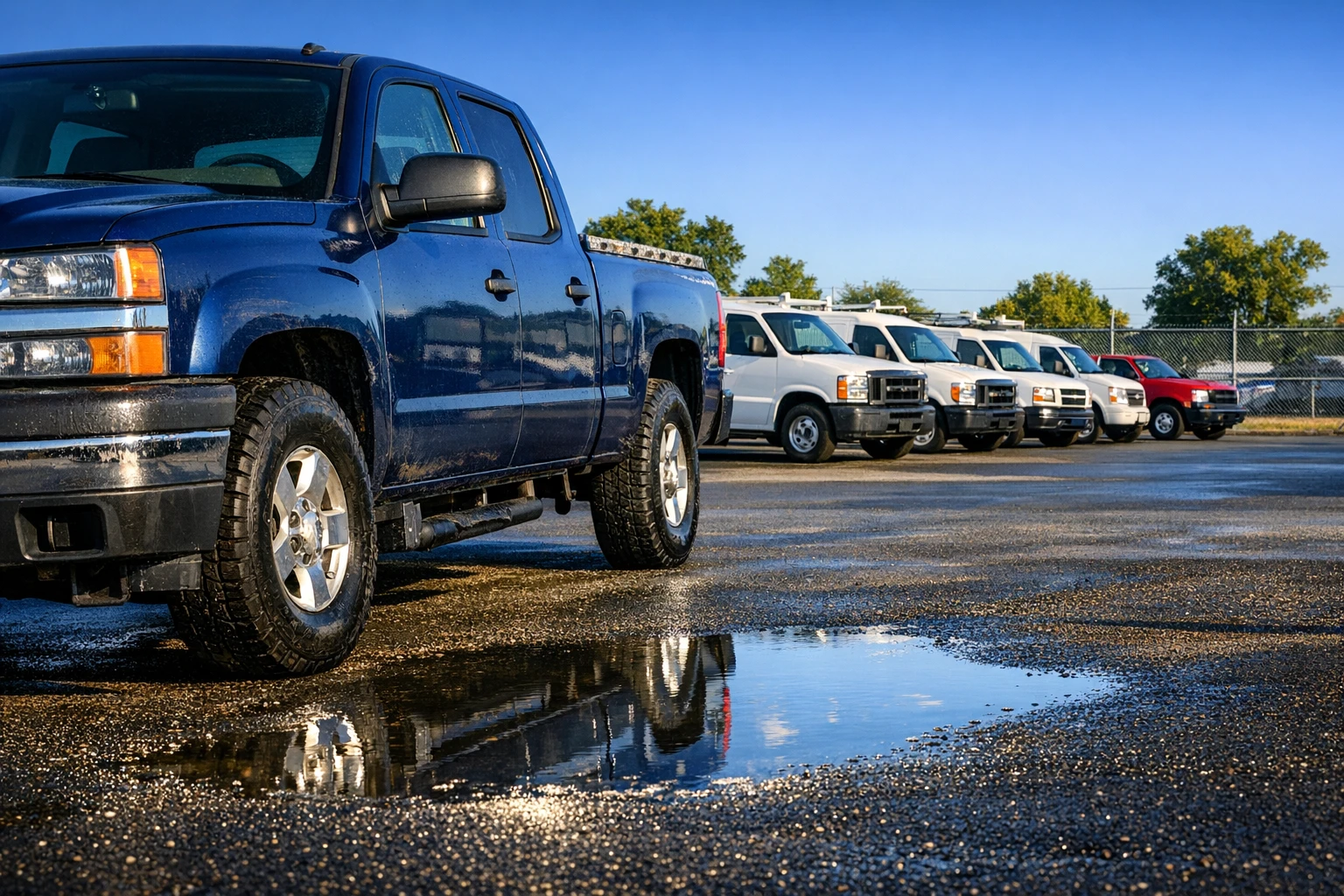
There is also a timing advantage. Municipal agencies, towing companies, and impound lots are not in the business of maximizing showroom appeal. They are trying to clear storage space, dispose of unclaimed vehicles, or rotate surplus fleet units. That difference in motive is where opportunity lives. Picture a row of dusty pickups under a bright morning sky: one might be a worn-out gamble, another a serviceable workhorse waiting for a careful buyer who did the homework. The goal of this article is not to sell a fantasy of easy steals, but to show how informed buyers can spot real value where others see confusion.
How Impound Auctions Offer Serious Savings on Trucks
Impound auctions can create real savings because the vehicles are usually sold for operational reasons, not merchandising reasons. A truck may end up in an impound sale because it was unclaimed after towing, involved in a legal hold that has been released, abandoned on private or public property, or stored long enough that the responsible party never retrieved it. Once the holding period ends and legal requirements are met, the truck is often auctioned to recover storage and administrative costs. That means the seller’s goal is commonly to convert an idle asset into cash quickly, not to hold out for top-dollar retail pricing.
That basic structure can produce lower entry prices than buyers see at dealerships or on polished online listings. A retail seller typically invests in cleaning, photography, inspections, sometimes minor repairs, and then adds margin. An impound auction seller often does far less. As a result, a buyer willing to accept cosmetic flaws, uncertain history, or the need for post-purchase maintenance may pay substantially less up front. In many markets, the difference can be thousands of dollars on older pickups and fleet trucks, especially half-ton and three-quarter-ton models that remain in demand among contractors, landscapers, and rural buyers.
Still, “cheap” does not automatically mean “good value.” Savings make sense only after you account for the full cost of ownership. Buyers should compare auction price plus fees, transport, registration, taxes, and repairs against the local private-party and dealer market. A truck won for $8,000 can become a $11,500 purchase very quickly if it needs tires, brakes, a battery, and title processing. On the other hand, a well-bought municipal or impound unit that needs only modest attention can still beat a $15,000 dealer listing by a wide margin.
- Lower starting bids are common because storage space and turnover matter
- Cosmetic imperfections often scare off casual buyers, reducing competition
- Fleet-style trucks may have plain interiors but stronger maintenance histories than expected
- Older models with useful payload or towing capacity can be overlooked by style-focused shoppers
Compared with private sellers, impound auctions also remove some of the negotiation theater. There is no long message thread, no vague promise that “everything works,” and usually no emotional pricing because the owner once loved the truck. Instead, the process is blunt: inspect, research, bid, pay, and move on. That directness is part of the appeal. It is not glamorous, but it can be efficient. For buyers who care more about value than shine, impound auctions are one of the few places where the used truck market still occasionally leaves money on the table.
What To Look For Before You Bid on Any Auction Truck
Auction success is built long before the bidding starts. The smartest buyers inspect the truck like they are trying to disqualify it, not convince themselves to buy it. Most auction vehicles are sold as-is, where-is, with limited or no guarantees, so your inspection process must be disciplined. Start with the basics: confirm the vehicle identification number, title status, odometer reading if available, and any notes about keys, engine condition, or whether the truck runs and drives. Some auctions publish this information online, while others reveal very little. When documentation is thin, your visual inspection becomes even more important.
Begin outside the truck. Look down the body lines for waviness that may suggest collision repair. Check the bed floor for heavy gouging, bent rails, or patched metal that hints at hard commercial labor. Inspect the frame for rust scaling, fresh undercoating that may hide corrosion, and bends near tow points. Uneven tire wear can suggest alignment issues, suspension wear, or poor maintenance. If the truck is a former fleet vehicle, scan for drill holes, decal shadows, utility rack mounts, and signs of removed equipment. Those clues are not necessarily bad. In fact, they often tell a useful story about how the truck was used.
Then move under the hood. Look for fluid leaks, cracked belts, damaged hoses, improvised wiring, and signs that recent cleaning may be masking a mess. Pull the oil dipstick if allowed. Check coolant color. Inspect the battery date. Smell matters too. Burnt transmission fluid, stale fuel, or heavy mildew can reveal neglect that glossy auction photos never mention. If the truck starts, listen for cold-start noise, uneven idle, and exhaust smoke. If it can move, note transmission behavior, steering feel, brake response, and warning lights. Some auctions do not allow test drives, but even a short lot movement can tell you a lot.
- Verify VIN, title type, keys, and sale terms
- Check frame condition, rust, suspension stance, and tire wear
- Look for leaks, warning lights, startup noise, and smoke
- Inspect the bed, hitch, towing wiring, and signs of overloading
- Estimate immediate repair costs before choosing a maximum bid
It also pays to understand truck-specific wear points. A pickup used for towing may show strain in the rear suspension, brake system, transmission, and hitch area. A former municipal truck may idle for long periods, which can age engine components differently than highway miles do. Diesel models require extra attention to emissions systems, injectors, turbo health, and maintenance history, because repairs in those areas can erase a bargain quickly. Four-wheel-drive trucks deserve checks for transfer case noise, mismatched tires, leaking axle seals, and front-end play.
One practical rule separates beginners from seasoned bidders: never inspect only with your eyes. Inspect with your calculator. A truck that needs $2,000 in immediate work is not automatically a bad buy, but it changes the ceiling of what you should pay. When you train yourself to convert flaws into numbers, the auction becomes less emotional and much more rational.
How to Bid Smart and Avoid the Expensive Mistakes First-Timers Make
Smart bidding starts with a number written down before the auction begins. Not a vague idea, not a hopeful range, but a hard maximum that includes every predictable expense. Buyers often focus so intensely on the hammer price that they forget the buyer’s premium, documentation fee, taxes, registration, towing, insurance, and initial repairs. Depending on the auction platform, fees can materially change the final cost. A truck that looks like a win at one price can become ordinary or overpriced once those extras are added.
The easiest way to stay disciplined is to work backward from local market value. Check dealer listings, private-party sales, vehicle history tools when available, and classifieds for similar year, trim, mileage, drivetrain, and condition. Then subtract estimated repairs and ownership costs. If comparable trucks sell privately for $14,000 and you expect $2,000 in repairs plus $800 in fees and transport, your ceiling should reflect that reality. There is no prize for “winning” a truck that no longer makes financial sense.
Timing matters too. Auction lanes can feel theatrical. The fast chant, the crowd energy, and the fear of missing a bargain can push calm people into foolish bids. This is sometimes called auction fever, and it is real. The cure is structure. Arrive early, inspect first, shortlist several trucks, and decide in advance which ones justify stronger bidding. If one goes too high, let it go. There will be another truck. Serious buyers protect capital; they do not chase ego.
- Set a maximum bid based on resale value minus repairs and fees
- Know whether the auction is absolute, reserve, online, or in-person
- Read payment deadlines, title terms, and vehicle removal rules
- Track several options so one missed truck does not force a bad decision
It is also wise to separate “needs work” from “needs mystery solved.” Repairs you can estimate, such as tires or brakes, are manageable. Unknown transmission issues, title complications, flood damage signs, or missing emissions equipment carry wider risk. Those trucks should attract either a very low bid or no bid at all. Another useful tactic is bringing a mechanically experienced friend or paying for a pre-auction inspection if the platform allows it. A second set of eyes can save thousands.
Online bidding adds another layer. It is convenient, but it can also make buyers overconfident because they are evaluating trucks through a screen. Always zoom in on body gaps, tires, dashboard warning lights, and bed condition. Read every line of the listing. Some trucks are described as “starts” but not “drives.” Some are sold with delayed title release. Those details matter.
The best bid is not the boldest one. It is the bid that still looks smart after the adrenaline wears off and the truck is parked in your driveway.
Why Police Auctions Stay Under the Radar and How to Find the Right Truck Sales Near You
Police auctions remain a best kept secret partly because many buyers misunderstand what they are. People hear “police auction” and imagine mystery, red tape, or vehicles with complicated backstories. In reality, many of these sales are simply disposal channels for unclaimed, seized, abandoned, or surplus vehicles handled under local rules. Some trucks come from impounds, some from municipal fleets, and some from law enforcement or public works departments rotating older units out of service. Because these auctions do not always advertise like dealerships, a large part of the buying public never sees them.
That lack of visibility can work in your favor. Retail truck shoppers usually search dealer websites, national listing platforms, and local classifieds. Fewer people think to check city surplus pages, county auction calendars, tow company notices, school district sales, or contracted auction platforms that host government inventory. Less competition does not guarantee a low price, but it can create calmer bidding on useful trucks that would attract far more attention in a polished retail setting.
To find police auctions for trucks, start local and stay systematic. Search city, county, and state government websites for terms like “surplus auction,” “impound vehicle auction,” “fleet disposal,” and “police auction trucks.” Many municipalities publish notices on official websites or through third-party auctioneers. Tow companies that manage impounded vehicles may also post auction schedules publicly because they are required to dispose of unclaimed vehicles after certain legal steps. In addition, regional auction houses often handle government contracts and maintain mailing lists for upcoming sales.
- Check city, county, sheriff, and state surplus pages
- Search tow lot and impound facility auction notices
- Register with reputable public auction platforms that list municipal inventory
- Call the auction contact and ask about preview dates, title type, and payment rules
- Look beyond pickups to cargo vans, utility bodies, and service trucks
When you find a sale, do not stop at the headline. Read terms carefully. Ask whether titles are clean, salvage, or rebuilt where applicable. Confirm whether the truck can be started during preview, whether keys are included, and whether the auction publishes maintenance records for fleet units. Surplus municipal trucks can be especially interesting because some departments keep regular service logs. These trucks may show cosmetic wear, idle hours, and holes from removed equipment, but they can also reflect predictable maintenance routines that private sellers cannot document.
For the target buyer, the opportunity is straightforward. If you are a contractor, landscaper, tradesperson, ranch owner, or practical shopper who values function over showroom gloss, police and impound auctions deserve a place in your search plan. They are not a shortcut that eliminates risk, and they are not ideal for every buyer. But if you can inspect carefully, calculate honestly, and walk away when the numbers stop working, these auctions can deliver a capable truck at a price that leaves room in your budget for repairs, tools, fuel, or business growth. That is the real secret: not hidden inventory alone, but disciplined buying where others never think to look.