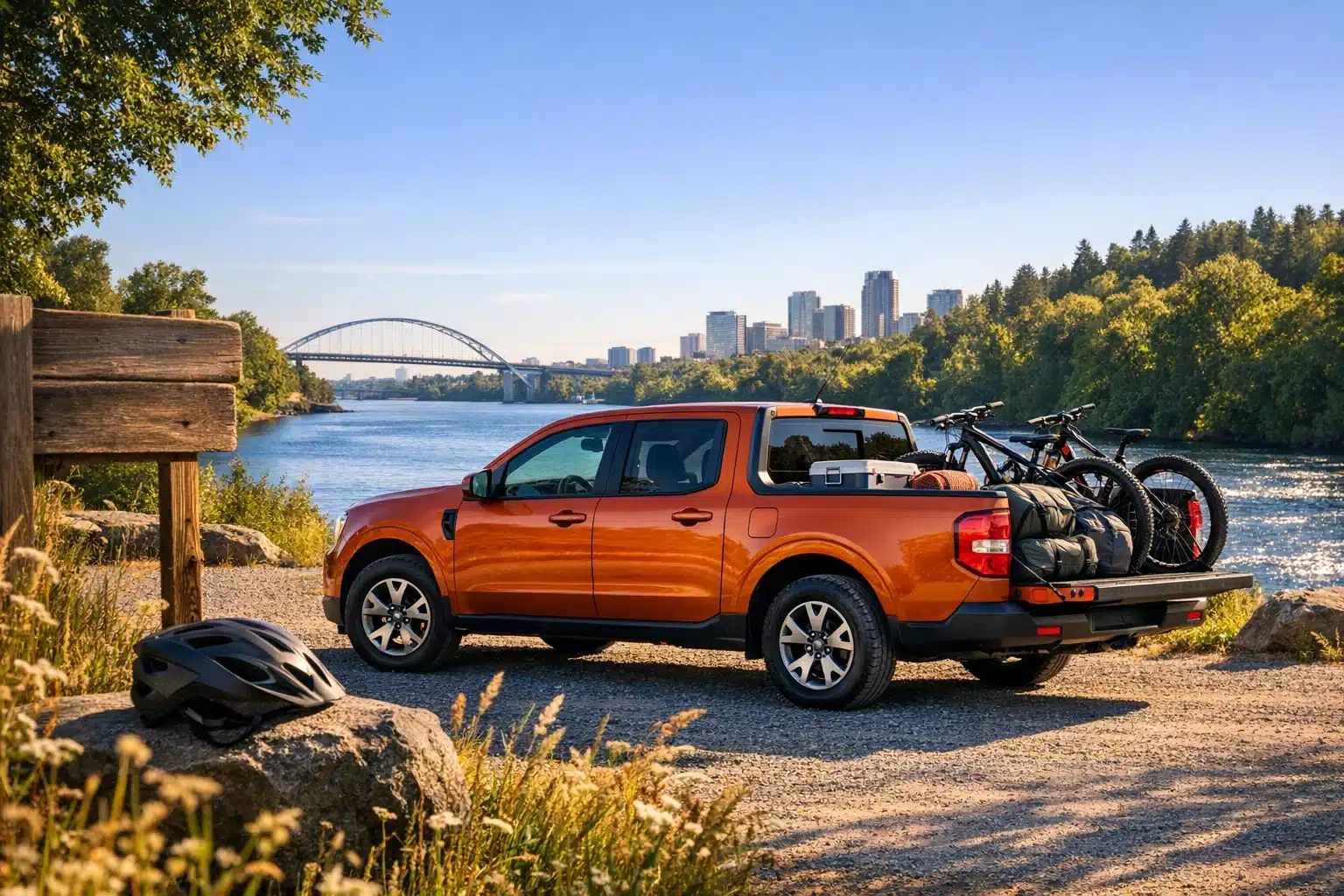
Why Everyone’s Talking About the 2026 Ford Maverick
Compact trucks used to feel like a forgotten middle ground, squeezed between compact SUVs on one side and towering full-size pickups on the other. The 2026 Ford Maverick changes that mood by making the small truck idea feel current, useful, and easy to justify in everyday life. It speaks to drivers who commute through crowded streets all week yet still want room for tools, bikes, mulch, or flat-pack furniture on Saturday. That blend of realism and versatility is exactly why so much attention has landed on this model.
This article follows a simple roadmap so readers can quickly see where the Maverick fits and why its relevance keeps growing.
- The first section explains how the Maverick helps expand the compact pickup market.
- The second examines features that make sense for urban driving and daily ownership.
- The third focuses on bed utility, towing, payload, and weekend-project flexibility.
- The fourth compares the Maverick with rivals, larger trucks, and crossover alternatives.
- The fifth concludes with a practical view of which buyers should look most closely at the 2026 Maverick.
The 2026 Ford Maverick and the Expanding Compact Pickup Market
The biggest reason the 2026 Ford Maverick matters is not just that it is a pickup, but that it keeps proving a compact pickup can be a serious mainstream vehicle rather than a niche curiosity. For years, American truck shopping largely drifted upward. Full-size pickups became more luxurious, more expensive, and physically larger. Mid-size trucks stayed relevant, but they also grew in price and capability, often moving closer to traditional truck expectations than everyday affordability. That left a wide opening for something smaller, easier to own, and less intimidating for people who had never considered themselves truck buyers.
The Maverick stepped directly into that opening. Since its arrival, it has helped reset expectations around what a pickup can be. Instead of building its identity around maximum towing bragging rights, it emphasizes accessible utility. Instead of asking buyers to accept the compromises of a giant vehicle, it presents a truck that can fit more naturally into normal life. In practical terms, that means a footprint of roughly 200 inches in recent Maverick generations, compared with well over 230 inches for many full-size pickups. That difference is not abstract on paper. It shows up in parking garages, apartment complexes, crowded downtown streets, and suburban driveways.
Several market forces explain why the Maverick has become such a talking point:
- More buyers want versatility without committing to a large truck.
- Rising vehicle prices have increased demand for value-focused choices.
- Fuel economy matters more to commuters than it did in many earlier truck cycles.
- Lifestyle use has become as important as heavy commercial use for many owners.
The Maverick also stands out because it blends pickup design with a unibody architecture, a layout more closely related to crossovers than traditional body-on-frame trucks. That helps deliver a friendlier ride and lower everyday operating burden, even if it also means the Maverick is not trying to replace heavy-duty or serious worksite trucks. In other words, the 2026 Maverick expands the compact pickup market by making the category feel normal, smart, and attainable. It turns the idea of a truck from an identity statement into a practical tool, and that shift is a big part of why so many people are paying attention.
Features and Flexibility for Urban Drivers
If the Maverick’s market role explains why it matters, its city-friendly design explains why so many people can actually imagine owning one. Urban drivers tend to face a very specific list of daily annoyances: tight parking spaces, stop-and-go traffic, narrow streets, rising fuel costs, and the simple fact that oversized vehicles can become tiring long before they feel impressive. The Maverick addresses that environment with a more manageable shape and a set of features that support daily use rather than occasional spectacle.
One of its most important advantages is size. A compact pickup still gives buyers the upright driving position and cargo separation they like about trucks, but it does so without demanding the turning radius and storage footprint of a full-size model. In city traffic, that changes the ownership experience. A truck that is easier to place in a lane and easier to reverse into a space feels less like a compromise and more like a clever solution. It is the difference between carrying capability and carrying unnecessary mass.
Recent Maverick model years have also built a strong reputation around efficiency, especially with hybrid configurations. In prior EPA ratings, hybrid Mavericks have posted city figures above 40 mpg, a number that dramatically reshapes what people expect from a pickup. That matters to commuters who spend five days a week driving to work and one day hauling supplies. A truck that behaves responsibly during the ordinary part of life becomes much easier to justify financially.
Urban-friendly practicality also comes from cabin design. A four-door layout, rear-seat storage, available infotainment features, and useful cubbies turn the Maverick into a vehicle that can handle groceries, backpacks, chargers, and tools without feeling cluttered. Buyers often look for the following qualities in a city-ready truck:
- Compact exterior dimensions for easier parking.
- Lower fuel consumption than traditional trucks.
- A comfortable ride for daily commuting.
- Useful technology for navigation, connectivity, and safety.
- Enough interior flexibility to replace a family crossover.
Compared with a compact SUV, the Maverick adds the clear advantage of an open bed, which is ideal for dirty, bulky, or awkward cargo that owners may not want inside the cabin. Compared with a full-size pickup, it asks far less of the driver in fuel, maneuvering effort, and storage space. That balance is why the Maverick resonates with apartment dwellers, city professionals, younger households, and even downsizing truck owners. It is not trying to dominate the road. It is trying to fit into a real schedule, and that may be the smartest truck feature of all.
Built for Weekend Projects, Outdoor Gear, and Real-World Utility
The Maverick’s appeal would be shallow if it were only easy to park. What makes the truck genuinely interesting is that it pairs everyday civility with useful weekend capability. For buyers who spend the week in office clothes and the weekend in work gloves, that dual personality is a major part of the story. The Maverick does not need to be a heavy-duty machine to be extremely helpful; it just needs to handle the tasks most owners actually face. In that sense, it behaves less like a downsized compromise and more like a well-edited tool kit.
The bed is central to that appeal. In recent Maverick generations, Ford’s FlexBed concept has included details such as molded slots for dividers, available tie-down solutions, and a multi-position tailgate that helps support longer cargo. That design matters because compact trucks live or die on usability. A 4.5-foot bed may sound modest next to bigger pickups, but the functionality is better than the raw number suggests. With the tailgate arrangement and thoughtful accessory planning, owners can carry gardening supplies, bicycles, camping equipment, home-improvement materials, and even certain sheet goods more effectively than many crossover buyers expect.
Payload and towing also help explain the Maverick’s versatility. Recent versions have offered payload figures around 1,500 pounds and, when properly equipped, towing capability up to 4,000 pounds on certain turbocharged configurations. Those numbers are not aimed at people hauling large construction trailers every day. They are, however, highly relevant for owners pulling a small utility trailer, a lightweight boat, personal watercraft, or a pair of motorcycles. That opens the door to much broader use than the Maverick’s compact profile might suggest.
Typical weekend scenarios where the Maverick makes sense include:
- Trips to the hardware store for lumber, soil, or tile.
- Hauling bikes, kayaks, or camping gear without dirtying the cabin.
- Moving small furniture pieces or flat-packed home items.
- Towing a light trailer for yard work or recreational equipment.
Compared with a compact SUV, the Maverick’s bed creates a cleaner separation between passengers and messy cargo. Compared with larger pickups, it avoids the feeling of bringing industrial equipment to a suburban errand list. That is where the truck’s personality shines. It is the kind of vehicle that can leave a coffee shop parking lot in the morning, stop at a garden center by noon, and spend the afternoon at a trailhead without looking out of place in any setting. The Maverick makes utility feel casual, and that easy competence is a big reason people keep talking about it.
How the Maverick Compares with Rivals, Larger Trucks, and Crossover Alternatives
No vehicle exists in a vacuum, and the 2026 Ford Maverick becomes even more interesting when viewed against its alternatives. Buyers do not simply ask whether the Maverick is good. They ask whether it is better for their lives than a compact SUV, a mid-size pickup, or another compact truck such as the Hyundai Santa Cruz. That is where the conversation becomes more nuanced, and also more useful.
Against traditional mid-size pickups like the Ford Ranger, Toyota Tacoma, Chevrolet Colorado, or Nissan Frontier, the Maverick offers a different kind of value. Those trucks generally deliver stronger towing, more serious off-road hardware in certain trims, and the durability image associated with body-on-frame construction. But they are often larger, more expensive, and less efficient in daily use. For buyers who do not need heavier capability, that extra truck can quickly become extra cost. The Maverick’s case is simple: it gives up some maximum performance in exchange for lower ownership friction.
Compared with the Hyundai Santa Cruz, the Maverick enters a more direct debate. Both target buyers who want pickup versatility without stepping into full-size territory. The Santa Cruz often leans more toward style, road-focused comfort, and a crossover-like presentation. The Maverick, by contrast, is widely seen as the more traditional small truck in spirit, with a more overt focus on utility and value. Neither approach is automatically better. The right choice depends on whether the buyer wants sportier lifestyle packaging or a more work-friendly, budget-conscious tool.
The Maverick also has to compete with crossovers, because many shoppers could buy a well-equipped SUV instead. Here the Maverick’s open bed becomes its biggest differentiator. It gives owners a better answer for muddy gear, tall plants, paint cans, or renovation debris. A crossover may provide enclosed cargo space and, in some cases, more polished rear-seat comfort, but it cannot duplicate the convenience of a bed for dirty or oversized loads.
For many buyers, the comparison comes down to four questions:
- How often will I really tow or haul heavy loads?
- Do I need city-friendly dimensions?
- Would a bed solve problems an SUV cannot solve cleanly?
- Am I paying for capability I will rarely use in a larger truck?
That decision framework helps explain the Maverick’s momentum. It lives in the sweet spot between too much truck and not enough utility. In a market crowded with vehicles that ask buyers to choose extremes, the Maverick succeeds by being intelligently moderate.
Conclusion: Who the 2026 Ford Maverick Makes the Most Sense For
The 2026 Ford Maverick makes the strongest case for itself among people whose lives are mixed rather than specialized. It is not built for the owner who tows heavy machinery every week, and it does not pretend to be the final answer for hard-core off-road use or high-capacity jobsite hauling. What it does offer is something many buyers have quietly wanted for years: a truck that respects normal life. That means a vehicle that can commute economically, fit in ordinary parking spaces, carry useful cargo, and handle weekend work without demanding full-size-truck sacrifices in return.
For urban drivers, the Maverick feels relevant because it turns truck ownership into a realistic daily choice. For first-time truck buyers, it lowers the intimidation factor. For homeowners and DIY enthusiasts, it provides a bed and useful payload without forcing a leap into much larger dimensions. For active households, it works as a gear-hauler that can carry bikes, coolers, gardening supplies, and travel equipment with less mess inside the cabin. Even for downsizing truck owners, it can feel like a refreshing correction after years of rising size and cost in the broader pickup market.
The target audience becomes even clearer when you think about routine rather than image. The Maverick suits buyers who spend more time running errands than crossing deserts, more time visiting home-improvement stores than pulling commercial trailers, and more time navigating suburbs and city streets than remote work sites. That is not a small audience. It is a huge and growing one.
If you are deciding whether the Maverick deserves the attention it is getting, a practical checklist helps:
- You want truck usefulness without full-size bulk.
- You value fuel efficiency and day-to-day drivability.
- You need a bed for dirty, awkward, or oversized cargo.
- You appreciate flexibility more than maximum towing numbers.
- You want a vehicle that can handle weekday routine and weekend plans with equal confidence.
That is why everyone keeps talking about the 2026 Ford Maverick. It represents a wider shift in what truck buyers are asking for: not bigger, not louder, but smarter. In a market where many vehicles still chase extremes, the Maverick wins attention by understanding the middle ground and making it useful again.